

Overview
Being overweight can increase the risk of lots of health problems in our pets, including diabetes, arthritis and even skin disease. Here are a few tips to help you assess whether your dog is at a healthy weight.
Don’t rely on breed weight guides
You may find average weight guides online for different dog breeds, but these aren’t always useful. There can be considerable variation in size and build, even between animals of the same breed. Two dogs of the same breed could be a healthy weight despite having quite different weights on the scales.
Get familiar with body condition scoring
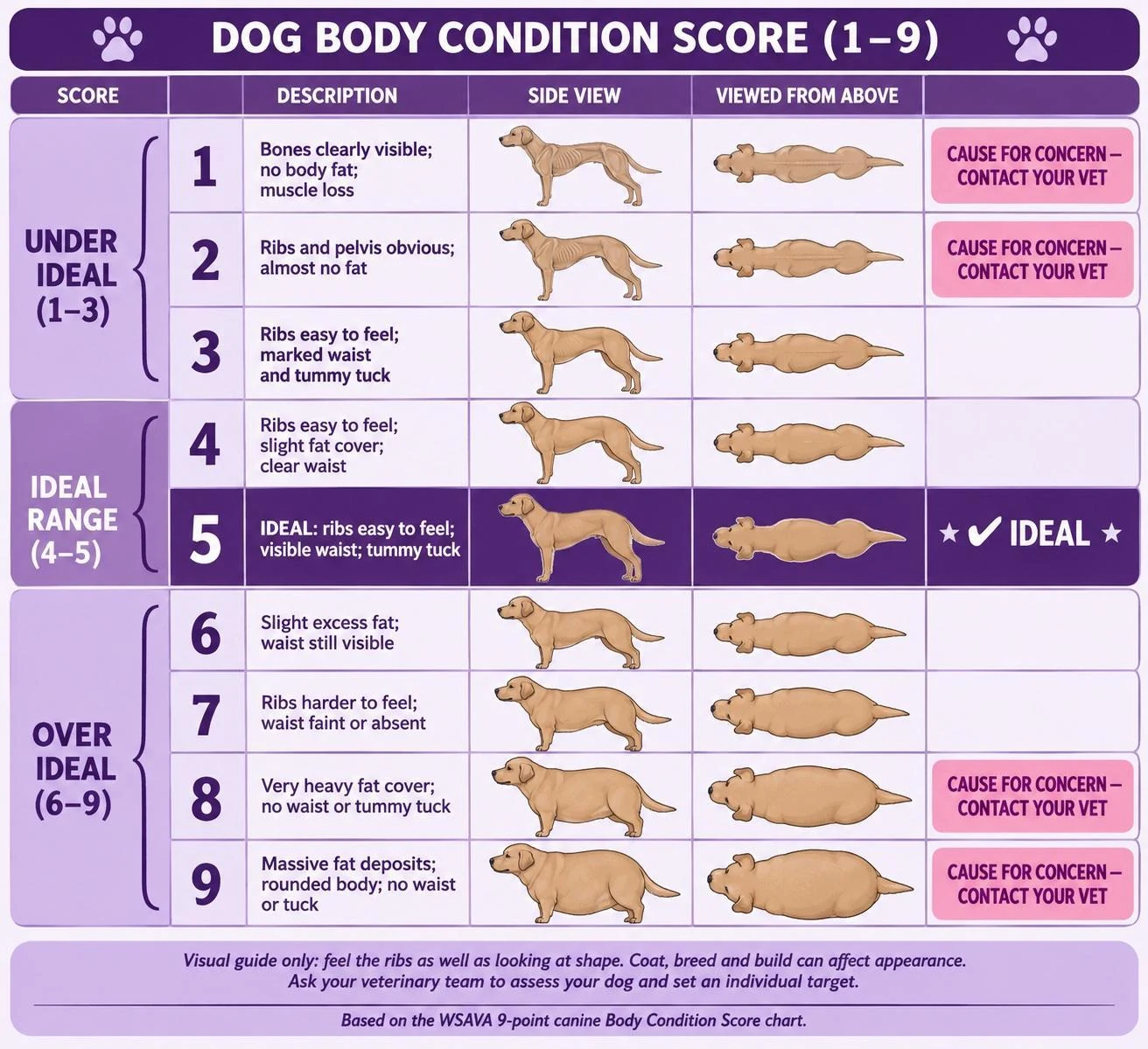
Body Condition Scoring (BCS) is a simple way of assessing whether your pet is underweight, at an ideal weight or overweight. It involves looking at and feeling your pet’s body shape, rather than relying on their weight alone. The score runs from 1 to 9, with 4 to 5 being the ideal range, 1 being severely underweight and 9 being severely overweight.
When viewed from above, your pet should have a visible waist behind their ribs. When viewed from the side, their tummy should tuck upwards towards their back legs. You should also be able to feel their ribs easily with gentle pressure, without them being too prominent. It should feel like you are running your fingers over the back of your hand with relaxed knuckles.
Ask your vet or vet nurse for advice
If you’re unsure whether your pet is overweight, your vet or vet nurse can carry out a body condition score and help establish a healthy target weight. They can also offer advice on portion sizes, diet and exercise to help your pet maintain a healthy weight.
Remember, even a small amount of extra weight can make a difference to your pet’s long-term health. Call us now to book your pet’s weight clinic appointment and give them the best foundation for a long, healthy life.
Check the evidence
Sources & further reading
Find more information in these resources.